



The mid revenue cycle is no longer a simple back-office function. It’s healthcare’s most powerful yet overlooked performance lever.
While most hospitals obsess over clinical quality scores and care coordination, the real opportunity to win in value based care lies in how you manage the middle of your revenue operations.
According to Experian Health’s State of Claims 2025 report, 41% of providers say over 10% of their claims are denied, driven largely by missing or inaccurate patient data and intake complexity.
That means hospitals could be losing millions not because of poor care, but because of gaps in accuracy.
At Bulwark, At Bulwark, we believe fixing the mid-cycle is the single biggest step hospitals can take to build financial resilience in value-based care. Let’s see how you can do that.

Why Mid-Revenue Cycle Is So Important
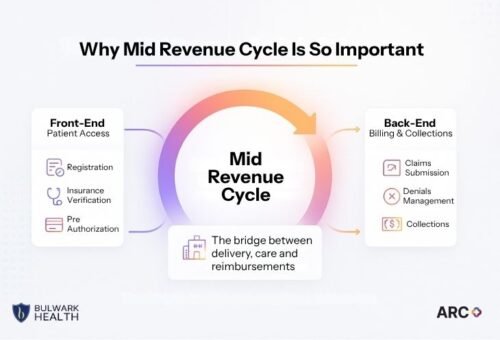
The mid revenue cycle is where clinical care translates into financial accuracy.
It connects patient access on the front end and billing or collections on the back end.
Every decision made here affects how revenue flows, how fast claims get paid, and how accurately hospitals get reimbursed.
Key components of the mid revenue cycle include:
- Clinical documentation integrity (CDI): Ensures provider documentation accurately represents patient acuity and services rendered.
- Coding and edits: Converts care notes into standardized ICD-10 and CPT codes for claims.
- Charge capture: Records all billable services to prevent missed revenue.
- Compliance and auditing: Ensures alignment with CMS and payer regulations.
- Revenue integrity: Reconciles financial and clinical data to avoid leakage.
This is the moment where a patient’s clinical story becomes data that drives both reimbursement and insight.
Without a precise mid-cycle, no amount of billing optimization on the back end can make up for missed charges or inaccurate documentation.
How to Track Mid-Revenue Cycle Performance
High-performing organizations treat the mid-cycle as a data system rather than a workflow.
They track specific revenue cycle management strategies to measure accuracy, productivity, and compliance.
These metrics aren’t just operational – they define how effectively your clinical and financial teams work together.
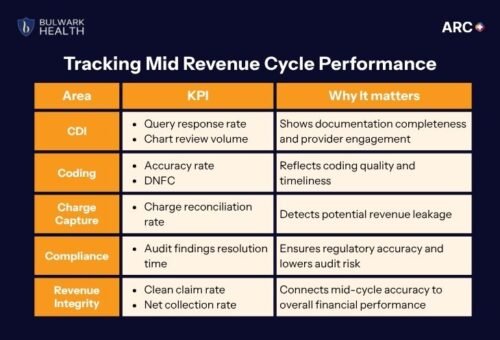
CDI
- KPI: Query response rate, chart review volume
- Why it matters: Shows documentation completeness and provider engagement
Coding
- KPI: Accuracy rate, days not final coded (DNFC)
- Why it matters: Reflects coding quality and timeliness
Charge Capture
- KPI: Charge reconciliation rate
- Why it matters: Detects potential revenue leakage
Compliance
- KPI: Audit findings resolution time
- Why it matters: Ensures regulatory accuracy and lowers audit risk
Revenue Integrity
- KPI: Clean claim rate, net collection rate
- Why it matters: Connects mid-cycle accuracy to overall financial performance
Tracking these KPIs ensures every part of the process, from CDI to claims. When that happens, hospitals see better VBC financial outcomes, fewer denials, and a more predictable revenue stream.
Recommended Read: Future of Medical Coding: NLP and AI at Work
The Mid-Revenue Cycle’s Role in Winning at Value-Based Care
For years, conversations about value based care focused on clinical improvement.
But financial performance under VBC depends on documentation precision and coding accuracy. The mid revenue cycle is where that precision lives.
When CDI, coding, and compliance align, hospitals can demonstrate the real cost and quality of care.
For example, CDI in ACO programs ensures patient acuity is captured correctly, supporting fair risk adjustment and accurate reimbursements.
DRG validation and charge reconciliation prevent undercoding and missed legitimate revenue
Accurate coding and edits strengthen transparency while reducing payer disputes.
According to Simbo AI’s 2024, optimizing mid-revenue cycle processes such as documentation and coding significantly improves reimbursements and financial stability in healthcare organizations.
That translation happens mid-cycle.
Recommended Read: Is Value Based Care a Mirage or a Missed Opportunity?
How AI is Adding Value
Artificial Intelligence is transforming how the mid revenue cycle operates.
Machine learning identifies documentation gaps, predicts denials, and automates repetitive coding tasks.
Natural Language Processing (NLP) converts unstructured clinical text into structured data, ensuring every comorbidity and condition is captured correctly.
Hospitals using AI to optimize mid-cycle processes report faster coding turnaround and fewer denials (Source: AKASA, 2025).
Technology doesn’t replace clinical or financial teams – it amplifies their accuracy, allowing them to focus on higher-value work.
How Bulwark Optimizes The Mid Revenue Cycle
At Bulwark, we help hospitals turn mid-cycle precision into measurable financial performance.
Bulwark’s ARC+ strengthens the mid revenue cycle by aligning clinical, coding, and compliance workflows to ensure accuracy, speed, and audit-readiness.
With ARC+, hospitals can:
- Automate charge reconciliation and prevent mid-cycle leakage.
- Validate DRGs and enhance coding accuracy.
- Identify documentation gaps impacting risk adjustment and quality outcomes.
- Accelerate clean claim generation and reduce denials.
For organizations scaling value-based care programs, ARC+ integrates seamlessly with downstream analytics through RAQ+, ensuring mid-cycle data flows into accurate risk and quality reporting without duplication.
Our integrated revenue cycle management platform connects every part of your revenue cycle operations, giving leaders visibility into both compliance and financial integrity.
With Bulwark, your mid revenue cycle solutions do more than reduce errors – they elevate care value.

Recommended Read: Strengthen Your CDI Program: DRG Validation with AI
FAQs
What is the mid revenue cycle in healthcare?
The mid revenue cycle covers everything between patient access and billing. It includes CDI, coding, charge capture, and compliance – essential steps that ensure care documentation is accurately converted into financial data for proper reimbursement.
How does the mid revenue cycle impact value-based care?
Accurate documentation and coding in the mid-cycle determine how well a hospital performs in value-based care programs. The better your mid-cycle accuracy, the stronger your risk adjustment, compliance, and overall VBC financial outcomes.
What tools improve mid revenue cycle management?
Solutions like Bulwark’s ARC+ help automate charge reconciliation, DRG validation, and CDI analytics to strengthen mid-cycle integrity. When paired with downstream analytics like RAQ+, hospitals can align their revenue cycle with value-based performance goals.
Conclusion: Stop Leaking Revenue, Start Winning at VBC
Winning at value based care isn’t just about improving clinical performance. In value-based care, financial integrity begins mid-cycle and ends in better outcomes
It’s about ensuring the financial story of that care is told accurately, compliantly, and completely. The mid revenue cycle is where that story is written.
Hospitals that modernize their mid-cycle with intelligent automation and analytics not only protect against denials, they also position themselves to thrive in value-based models.
With the right balance of precision, technology, and collaboration, your mid – cycle revenue becomes a true driver of VBC financial outcomes.
At Bulwark, we’re building that foundation. Because when your mid-cycle runs right, your entire system performs better – financially and clinically.
Book a demo today to see how Bulwark fits into your system.